

OCD vs OCPD: What's the Difference?
If you've ever wondered whether your need for order, your racing thoughts, or your relentless perfectionism might be "something more," you're not alone. OCD and OCPD are two of the most commonly confused mental disorders in clinical practice, and the similar names don't help. Let me walk you through what actually separates them, why it matters, and what to do about it.
Quick Answer: OCD vs OCPD in Everyday Life
As a therapist, one of the first things I'd want you to understand is this: obsessive compulsive disorder and obsessive compulsive personality disorder may share a name, but they feel completely different from the inside.
Obsessive compulsive disorder (OCD) is an anxiety-driven clinical syndrome built around intrusive thoughts (obsessions) and repetitive behaviors or mental rituals (compulsions) that the person feels compelled to perform. These obsessions and compulsions feel unwanted, distressing, and often irrational to the person experiencing them. Think of someone who checks the stove 20 times before leaving the house, knowing it's excessive but unable to stop because the anxiety is overwhelming.
Obsessive compulsive personality disorder (OCPD), on the other hand, is a personality disorder defined by a lifelong pattern of rigid perfectionism, control, and orderliness that typically feels "right" or necessary to the person. Picture someone who rewrites a report all night because no version is ever quite good enough, not because of a specific fear, but because their internal standards demand it. They might even feel proud of this dedication.
Here's the key idea: OCD is ego-dystonic, meaning symptoms feel foreign and distressing to individuals. OCPD is ego-syntonic, meaning individuals view their traits and behaviors as rational and correct. This single distinction shapes almost everything about how these two disorders show up, how they're diagnosed, and how we treat them.
It's worth noting that both OCD and OCPD can coexist in an individual, and misdiagnosis between the two is surprisingly common. When we get the diagnosis wrong, people end up in treatment that doesn't address the real problem, and relief takes much longer than it should.
The reassuring truth: both are treatable mental health conditions. At The Therapy Space, we prioritize careful, compassionate assessment before jumping into any treatment plan.
What Is Obsessive Compulsive Disorder (OCD)?
OCD is classified as an obsessive-compulsive and related disorder in the Diagnostic and Statistical Manual of Mental Disorders (DSM-5-TR), published by the American Psychiatric Association. It sits in its own diagnostic chapter, separate from personality disorders entirely.
The cycle works like this: an intrusive, unwanted thought (obsession) triggers intense anxiety. To reduce that anxiety, the person performs a compulsive action or mental ritual. This brings temporary relief, but the obsession returns, often stronger, and the cycle repeats.
For example, someone might experience the sudden, vivid thought that they've left the front door unlocked and an intruder will break in. The anxiety builds until they physically go back and check. They check once, twice, maybe fifteen times, and even then, the doubt lingers.
Obsessions are not just everyday worries. They are sticky, repetitive, intrusive thoughts or images that feel impossible to dismiss. OCD involves true obsessions and compulsions, and OCD behaviors are often performed to neutralize a feared outcome or reduce anxiety.
Common OCD symptoms readers might recognize include:
- Repeated checking of locks, stoves, or appliances
- Excessive handwashing or cleaning rituals
- Counting, tapping, or repeating phrases silently
- Mental reviewing of past events or conversations
- Reassurance seeking from others
OCD symptoms fluctuate with anxiety levels and tend to worsen under stress. These time-consuming rituals often consume more than an hour per day, cause significant distress, and interfere with work, school, and relationships. The impact on a person's life can be enormous.
Common Obsessions and Compulsions in OCD
Obsessive compulsive presentations come in many forms, and they rarely look like the stereotypical image of someone lining up pencils. Let me describe what I actually see in practice.
Common obsessions include:
- Contamination fears (germs, illness, bodily fluids)
- Harm obsessions (fear of accidentally causing harm to someone, or fear of causing a car accident)
- Symmetry or "just right" sensations
- Unwanted sexual or violent images
- Blasphemous or "immoral" obsessive thoughts
- Existential worries about meaning, reality, or identity
Common compulsions include:
- Washing and cleaning rituals
- Checking doors, appliances, or locks repeatedly
- Arranging objects for symmetry or order
- Counting or repeating specific phrases
- Reviewing memories or past actions mentally
- Seeking reassurance from family members or friends
Some compulsions are entirely invisible. Mental rituals like silently praying, reviewing conversations, or mentally "canceling" a bad thought happen inside someone's head. This means OCD is often missed, even by people close to the person.
Here's a clinical example: a mother experiences the intrusive thought that she might harm her child. She is horrified, because this thought is completely contrary to her values. She begins avoiding sharp objects, then avoiding being alone with her child, then spending hours mentally reassuring herself. The obsessive thoughts feel alien and terrifying. She doesn't want to act on them; that clash between the thought and her values is the hallmark of OCD.
Having disturbing intrusive thoughts does not mean you agree with them or want to act on them. If anything, the distress you feel is evidence of how much these thoughts conflict with who you are.
What Is Obsessive Compulsive Personality Disorder (OCPD)?
Obsessive compulsive personality disorder (OCPD) looks quite different in the therapy room. It's a long-standing pattern of perfectionism, orderliness, and control that begins by early adulthood and shows up consistently across many situations: at work, at home, and in relationships.
OCPD is a personality disorder, not an anxiety disorder. It describes a style of relating to oneself, others, and the world. OCD typically develops later in life due to various factors, while OCPD is often evident by early adulthood. OCPD does not feature traditional obsessions or compulsions in the way OCD does. Instead, it is characterized by rigid perfectionism and control.
Core features include:
- Preoccupation with details, rules, lists, and schedules
- Extreme perfectionism that actually interferes with finishing tasks
- Excessive devotion to work at the expense of leisure and relationships
- Reluctance to delegate tasks unless others do things exactly "their way"
- Rigid adherence to moral codes, values, and routines
- Miserly spending habits
- Difficulty discarding worthless items
Consider this example: a manager rewrites everyone's reports because no one else meets their standard. They work late every night, cancel plans with friends regularly, and become visibly upset when a project timeline shifts. They don't check things repeatedly out of fear. They simply believe their standard is the correct one and that others should meet it.
Many OCPD traits are socially rewarded. Being called "detail-oriented" or "dedicated" can mask what's actually a rigid, inflexible pattern. People with OCPD often struggle with interpersonal relationships because partners or children feel controlled, criticized, or like nothing is ever good enough.
In clinical practice at The Therapy Space, people with OCPD frequently first seek help for burnout, relationship strain, or depression, not for the personality traits themselves. OCPD symptoms are persistent and unchanging, unlike the waxing and waning quality of OCD.
Recognizing OCPD Symptoms
Here's a concise look at typical OCPD symptoms in everyday language, loosely aligned with the DSM-5-TR criteria:
- Detail fixation: Spending so long on lists, schedules, or organizing that the actual point of the task gets lost.
- Perfectionism blocking completion: Starting projects but never finishing because nothing meets the standard.
- Overwork: Working 10–12 hour days routinely, not because a deadline demands it, but because the person's internal rules require it.
- Moral rigidity: Strict, inflexible values applied to themselves and others.
- Hoarding tendencies: Difficulty discarding worn out or worthless items, "just in case."
- Control over others: Reluctance to delegate tasks, micromanaging, rewriting others' work.
- Miserly spending: Viewing money as something to be hoarded for future catastrophes.
- Stubbornness: Difficulty changing plans, admitting mistakes, or considering alternative perspectives.
To diagnose OCPD, at least four of these symptoms must be present, and they must disrupt daily functioning significantly. This is what separates OCPD from simply being "neat" or "type A." When these patterns genuinely impair your relationships, your ability to rest, or your capacity to collaborate with others, we're looking at something clinically meaningful.
People with OCPD may not see these behaviors as a problem. Often, the people around them experience the most distress. If you recognize yourself in this list, please don't self-diagnose. Use it as a starting point for a conversation with a mental health professional.
Ego-Dystonic vs Ego-Syntonic: Why OCD and OCPD Feel So Different
These two terms sound academic, but they describe something you'd immediately recognize in real life.
Ego-dystonic means the experience feels like it doesn't belong to you. With OCD, individuals with OCD recognize their behaviors are excessive or irrational. They know the checking, the washing, the mental rituals don't make logical sense. They feel trapped, embarrassed, sometimes ashamed. OCD symptoms typically cause individuals to feel distress. The person usually wants desperately to stop.
Ego-syntonic means the experience feels like a natural extension of who you are. With OCPD, the rigid standards, the need to maintain control, the perfectionism all feel justified. The person often sees the problem as external: "My partner doesn't care about quality," or "My team is lazy." OCPD traits often cause distress to others rather than to the person with the traits.
Here's a contrasting example: a person with OCD checks the door lock five times, feels ashamed, and wishes they could just walk away. A person with OCPD meticulously reviews every detail of a team project, feels justified, and becomes frustrated that no one else shares their standards.
This difference profoundly affects motivation for treatment. OCD patients often come to therapy with an overwhelming need for relief from compulsive behaviors. People with OCPD may present because a partner threatened to leave, a colleague filed a complaint, or burnout finally caught up with them. Exploring this distinction is a key part of differential diagnosis in therapy at The Therapy Space.

How Are OCD and OCPD Diagnosed?
Neither condition can be diagnosed from an online quiz. Accurate diagnosis requires careful clinical assessment by a licensed mental health professional.
OCD diagnosis involves a detailed clinical interview exploring the nature of obsessions and compulsions, how much time they consume, the level of distress, and impact on social, academic, or occupational functioning. Clinicians assess insight: does the person recognize these fears may not be realistic? The statistical manual specifies an insight specifier for this reason.
OCPD diagnosis involves mapping the history of personality traits back to adolescence or early adulthood, assessing stability across multiple settings (home, work, relationships), and confirming at least four DSM-5-TR criteria. OCPD is diagnosed in twice as many men as women, though this may partly reflect referral bias. OCPD prevalence in outpatient settings is approximately 8.7%.
OCD and OCPD share overlapping symptoms, complicating diagnosis. OCPD diagnosed often involves ruling out or differentiating from obsessive compulsive disorder, autism spectrum conditions, eating disorders, avoidant personality disorder, narcissistic personality disorder, and other personality disorders. Some clinicians at places like the New York State Psychiatric Institute and similar institutions specializing in clinical psychiatry use structured interviews to improve diagnostic precision.
Input from partners or family members can be incredibly helpful, especially when there is limited self-awareness. Mislabeling OCPD as OCD, or vice versa, can lead to unhelpful treatment plans and unnecessary suffering.
OCD and OCPD Prevalence and Co-Occurrence
OCD affects 2% to 3% of the general population. OCPD has a lifetime prevalence rate of 3% to 8%, making it one of the most common personality disorders.
The co-occurrence between these two disorders is clinically significant. OCPD occurs in 15% to 28% of individuals with OCD. Looking from the other direction, research suggests that 20% to 30% of OCPD patients also have OCD. A recent multi-clinic study found that 18.6% of OCD patients also met criteria for OCPD.
This co occurrence changes the clinical picture considerably. When both OCD and OCPD are present, patients tend to show:
- Longer duration of untreated illness (approximately 9.2 years vs 6.1 years for OCD alone)
- Older age at first treatment
- More severe hoarding, symmetry, and ordering symptoms
- Potentially poorer insight
Individuals with both disorders may respond poorly to therapy compared to those with only one condition, which is why identifying both early matters so much. OCPD traits like perfectionism and hoarding are common in OCD, creating further diagnostic complexity.
In therapy, this means we may need to address both the anxiety-driven rituals of OCD and the deeper personality patterns of control, rigidity, and self-worth that come with OCPD.
OCD vs OCPD: Key Differences at a Glance
Here's a side-by-side comparison to anchor what we've covered:
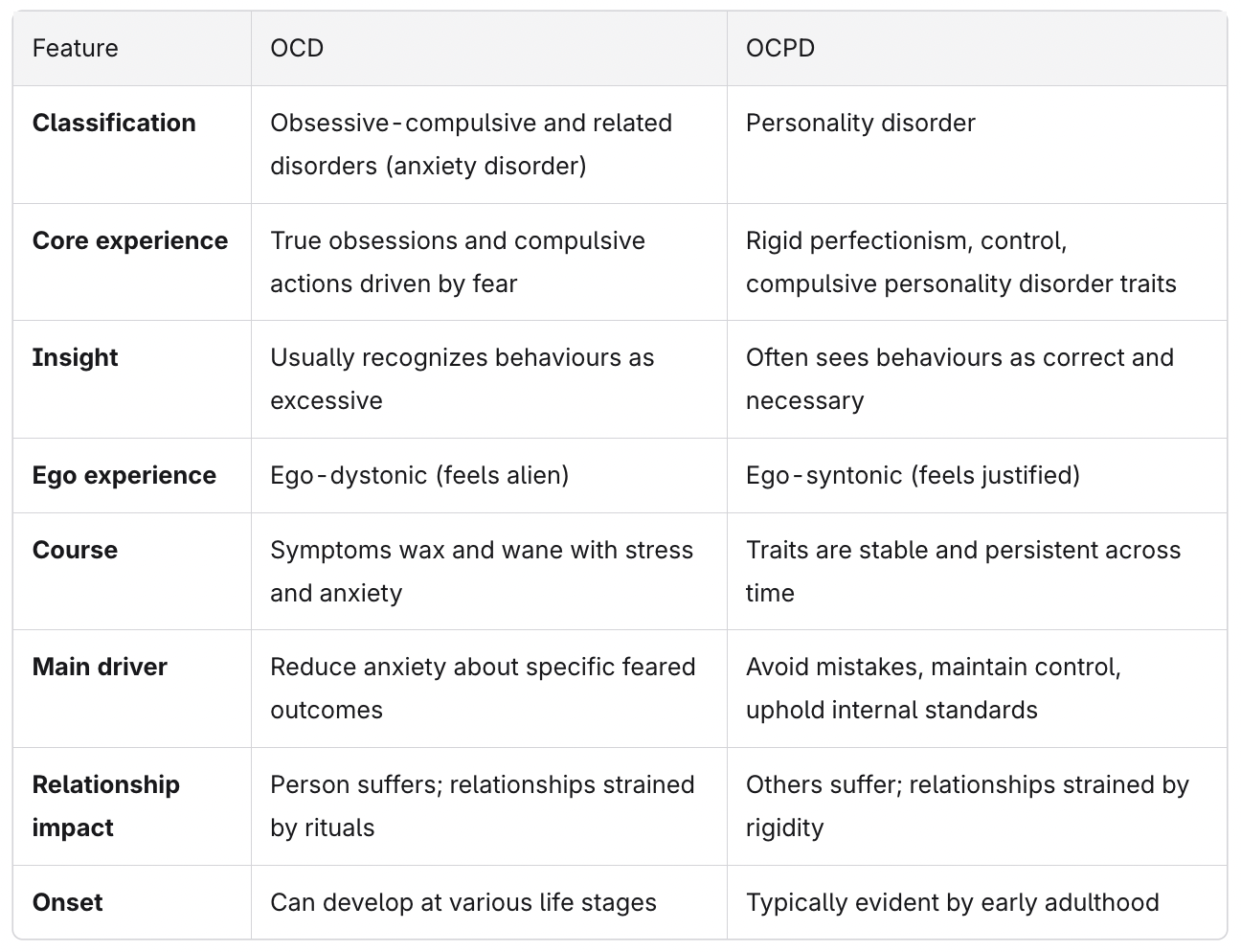
It's entirely possible to be very orderly and perfectionistic without having OCD. And someone with severe OCD might actually be quite flexible and warm in their relationships once the compulsions are reduced. These are genuinely distinct disorders that require different clinical approaches.

Treatment Approaches: OCD vs OCPD
Both obsessive compulsive disorder OCD and compulsive personality disorder OCPD are treatable, but they typically require different therapeutic strategies.
OCD Treatment
The first-line psychotherapy for OCD is Exposure and Response Prevention (ERP), a specialized form of behavioral therapy where clients gradually face feared situations without performing compulsions. Meta-analyses show large effect sizes (g ≈ 0.74) for cognitive-behavioral therapy with ERP compared to non-active controls. What is cognitive behavioural therapy and how it works is worth understanding if you're exploring OCD treatment.
SSRIs are commonly used for OCD treatment, either alone or combined with ERP. Combined treatment yields significantly greater improvements than medication alone. The goal is breaking the obsession-compulsion loop and learning to tolerate uncertainty without performing repetitive behaviors.
OCPD Treatment
OCPD treatment primarily involves longer-term psychotherapy aimed at cognitive flexibility and interpersonal functioning. Psychotherapy is the primary treatment for OCPD. Approaches include CBT focused on perfectionism, schema therapy, and psychodynamic therapy. Schema therapy may be beneficial for OCPD; one trial showed approximately 81% recovery after three years of schema therapy versus 52% in treatment-as-usual.
Medication may help control OCPD symptoms, especially anxiety or co-occurring depression, but there is less research supporting medication for the personality traits themselves. More research is needed in this area.
At The Therapy Space, therapists collaborate with clients to decide whether to begin with OCD symptom reduction, personality work, or both, depending on safety, impairment, and what the person most needs.
Living With OCD, OCPD, or Both
Living with either condition can leave you feeling worn out, caught in cycles of shame, conflict with loved ones, and the persistent sense of never feeling "good enough" or "safe enough."
Here are some grounded, practical ideas:
- Psychoeducation matters. Understanding the difference between OCD and OCPD helps you recognize what's happening and why, reducing self-blame.
- Self care isn't indulgent. For someone with OCPD especially, rest can feel like laziness. Gradual behavioral experiments, like leaving a task "good enough," can be transformative.
- Communication in relationships. Naming what's happening without blame helps partners and family members understand the feelings and behaviors driving conflict.
Let me address two common myths. "Being tidy means you have OCD" is false; neatness alone isn't OCD. And "everyone with OCPD is abusive" is equally inaccurate. Many people with OCPD are deeply caring; they're just rigid in how they express it.
Partners and family members can help by not participating in compulsive behaviors (for OCD) and gently naming rigid patterns without attacking (for OCPD). Normalizing ambivalence about change is important: letting go of control may feel dangerous, and therapy needs to proceed at a pace that respects this.
Don't wait until burnout, depression, or relationship breakdown forces a crisis. The earlier you seek additional support, the more options you have.
Finding Help and Reliable OCD/OCPD Resources
If you're wondering whether you might be dealing with OCD, OCPD, or both, here are concrete starting points:
- Book an assessment with a licensed therapist experienced in obsessive compulsive presentations and personality disorders. Individual therapy is a good place to start.
- Talk with your GP or psychiatrist about your symptoms as a first step toward an accurate diagnosis.
- Use screening tools as conversation starters, not final answers.
The International OCD Foundation is one of the most respected organizations for reliable information about OCD symptoms, treatment options, and how to find clinicians with OCD expertise. They also offer a supportive community for people navigating these related disorders.
When interviewing potential therapists, ask about their experience with both OCD and OCPD, their training in exposure and response prevention, and whether they work with personality-focused therapies. The Therapy Space works with adults, teens, and couples affected by OCD and OCPD through OCD therapy in Toronto and OCD therapy in Mississauga, emphasizing trauma-informed, collaborative, and non-shaming care.
Change is possible, even if these patterns have been with you for years. The first step is simply talking openly about what you're experiencing. You don't need to have it all figured out before you reach out.
-


.png)


